Delivering a multilingual document
Actuate software uses the Unicode character set standard to provide multilingual, cross-platform, language-independent reporting. Unicode organizes languages according to locales. A locale is a location plus the language, date and time formats, currency representation, sort order, and other conventions of that location. A locale is not necessarily a country. Using Unicode, Actuate software supports:

Diacritics such as the tilde (~)
Composite characters such as
≅ External font libraries
Multiple currencies in a single document
Actuate software does not support encoding logos or graphics, font variants, line breaks, or orientation of on-screen characters.
To prompt BIRT iHub to generate a response in the language of that locale, set the Locale parameter in the header of a SOAP envelope. When you do so, the response also uses the date and time formats, currency, and other conventions for that locale. Parameters return in the specified locale. If you specify an invalid locale, the response returns in the default locale, US English. If you do not choose a locale, the response returns in the default locale of the document user’s BIRT iHub.
The following SOAP header requests output formatted for the Greek language and locale:
<SOAP-ENV:Header>
<TargetVolume>Grandee</TargetVolume>
<Locale>el_GR</Locale>
</SOAP-ENV:Header>
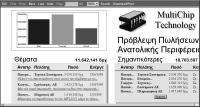
The response returns document content and parameters formatted for the specified locale, as shown in
Figure 4‑2.
Figure 4‑2 Output formatted for the Greek language and locale